
HTTP API
This page lists everything Musonic Server answers over HTTP, for developers who write a client, a script or an integration. It is taken from the server’s source code (apps/server/src), version 1.2.1.
What you need
- A running Musonic Server and its address (in the examples:
https://music.example.com). - An account on it. For scripts, create an API key for the device (see Authentication).
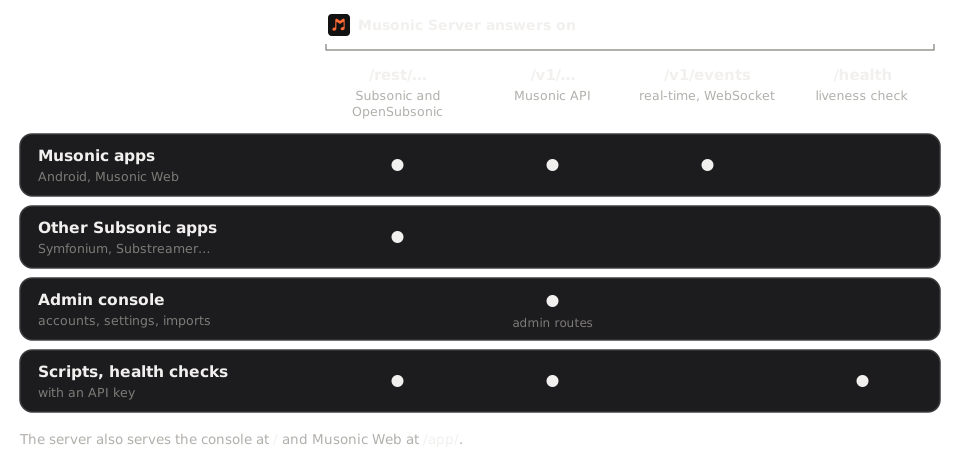
Musonic Server exposes three things:
| Base path | What it is | Format |
|---|---|---|
/rest/<endpoint> |
The Subsonic / OpenSubsonic API, used by Musonic and by any Subsonic client | XML by default, JSON with f=json |
/v1/... |
The native API of Musonic: accounts, sign-in, real-time events, administration | JSON |
/health |
Liveness check, without sign-in | JSON |
It also serves two web apps: the administration console at the server’s address (/, and any path that is not an API), and Musonic Web at /app/ once it is installed from the console.
Who uses which part:
- The Musonic apps (Android, Musonic Web):
/rest,/v1and the real-time WebSocket/v1/events. - Other Subsonic apps (Symfonium, Substreamer…):
/restonly. - The administration console: the
/v1routes (accounts, settings, imports, and the admin routes). - Scripts and health checks:
/restand/v1with an API key, and/healthwithout sign-in.
Subsonic and OpenSubsonic API
Section titled “Subsonic and OpenSubsonic API”Version and answer format
Section titled “Version and answer format”- Subsonic API version advertised: 1.16.1.
- Every answer carries
status(okorfailed),version(1.16.1),type(musonic),serverVersion(the server’s version) andopenSubsonic: true. - Routes answer at
/rest/<endpoint>and/rest/<endpoint>.view, with any HTTP method. - Parameters are read from the query string and from a form body (
application/x-www-form-urlencoded, the OpenSubsonicformPostextension). Repeated keys are kept (id=a&id=b). - Answers are XML by default, JSON with
f=json, JSONP withf=jsonp&callback=<name>(letters, digits,_and., 64 characters at most; otherwise JSON). - Errors use the Subsonic codes:
0generic,10missing parameter,40wrong credentials,41token sign-in not available,42mechanism not supported,43conflicting mechanisms,44invalid API key,50not authorized,70not found.
Authentication
Section titled “Authentication”Every route except getOpenSubsonicExtensions needs credentials. Three methods are accepted:
| Method | Parameters | Notes |
|---|---|---|
API key (OpenSubsonic apiKeyAuthentication) |
apiKey=<key> |
Recommended. Keys start with msk_. Must not be combined with u, p, t or s (error 43). |
| Password | u=<user>&p=<password> or p=enc:<hex> |
The password in clear or hex-encoded after enc:. Use it only over HTTPS. |
| Token and salt (classic Subsonic) | u=<user>&t=<md5(password + salt)>&s=<salt> |
Works only while the server setting legacy_auth is on (the default). When it is off, the server answers error 41 and asks for apiKey. |
<key>: an API key created in the app, in the console, or withPOST /v1/me/api-keys(shown once).<user>,<password>: the account’s username and password.<salt>: a random string you choose for each request;<md5(password + salt)>is the MD5 hash, in hex, of the password followed by that salt.
curl "https://music.example.com/rest/ping?apiKey=<key>&c=my-script&f=json"A suspended account gets error 50 with the message “This account is suspended”.
OpenSubsonic extensions
Section titled “OpenSubsonic extensions”getOpenSubsonicExtensions answers without credentials:
| Extension | Versions | Meaning |
|---|---|---|
apiKeyAuthentication |
1 | apiKey parameter, tokenInfo |
formPost |
1 | Parameters in a form body |
indexBasedQueue |
1 | savePlayQueueByIndex, getPlayQueueByIndex |
musonicServer |
1, 2, 3, 4 | The server is Musonic Server. 2: the one-request routes getMusonicLibrary, getMusonicHome, getMusonicHomeMore. 3: short ids (old UUIDs still accepted). 4: podcasts (searchPodcasts, savePodcastPosition, listening positions). |
A client can check for musonicServer (or call GET /v1/info) to use Musonic’s extras, and keep working with any other Subsonic server.
Implemented endpoints
Section titled “Implemented endpoints”Any other endpoint answers error 0 “<name> is not implemented yet”.
System
Section titled “System”| Endpoint | Notes |
|---|---|
ping |
Empty answer. |
getLicense |
Always valid: true. |
getOpenSubsonicExtensions |
No credentials needed. |
tokenInfo |
Only with apiKey (error 42 otherwise). Returns the username. |
getScanStatus |
scanning, number of files and folders, last scan. |
startScan |
Administrators only. fullScan=true reads every file again. Error if no music folder is configured. |
| Endpoint | Notes |
|---|---|
getUser |
Yourself; any account for an administrator. Roles are fixed: downloadRole, playlistRole, streamRole, coverArtRole, commentRole, settingsRole are true; uploadRole, podcastRole, jukeboxRole, shareRole, videoConversionRole are false. Rights set in the console are not reflected here. |
getUsers |
Administrators only. |
createUser |
Administrators only. username, password (clear or enc:), adminRole=true. Passwords need 8 characters or more. |
deleteUser |
Administrators only. |
changePassword |
Yourself; any account for an administrator. |
Browsing
Section titled “Browsing”| Endpoint | Notes |
|---|---|
getMusicFolders |
The configured music folder. musicFolderId is accepted by clients but ignored by the other routes. |
getIndexes, getArtists |
Album artists, A–Z. |
getMusicDirectory |
Folder browsing. |
getArtist, getAlbum, getSong |
Also take online ids (dz-…, see Ids) when the online catalog is on and the account may use it. getArtist adds the rest of the artist’s discography from the online catalog. |
getGenres, getSongsByGenre |
|
getAlbumList, getAlbumList2 |
The usual type values (recent, frequent, newest, random…). |
getRandomSongs |
size, genre, fromYear, toYear. |
getStarred, getStarred2 |
The account’s likes. |
getTopSongs |
artist (a name): the artist’s songs ordered by play counts on this server (no external service). |
getSimilarSongs, getSimilarSongs2 |
A radio built from the same artists and genres, shuffled. |
getArtistInfo, getArtistInfo2 |
No biography. Similar artists are the ones sharing the most genres. |
getAlbumInfo, getAlbumInfo2 |
Empty notes. |
search2, search3 |
Library, plus online results when the online catalog is on and allowed for the account. |
Likes, ratings, plays, queue
Section titled “Likes, ratings, plays, queue”| Endpoint | Notes |
|---|---|
star, unstar |
id, albumId, artistId. An online id is added to the library first (and may be imported, see Online catalogue). |
setRating |
|
scrobble |
submission=false only marks “now playing”; otherwise each id (with its time, in ms) counts as played. |
getNowPlaying |
|
savePlayQueue, getPlayQueue |
|
savePlayQueueByIndex, getPlayQueueByIndex |
OpenSubsonic indexBasedQueue. |
Playlists
Section titled “Playlists”| Endpoint | Notes |
|---|---|
getPlaylists, getPlaylist |
|
createPlaylist, updatePlaylist, deletePlaylist |
Only the owner edits a playlist. Making it public needs the right to do so (set per account in the console). Online ids can be added. |
| Endpoint | Notes |
|---|---|
stream |
The file itself, with HTTP ranges, or a transcoding by ffmpeg. See Streaming. |
download |
The original file. Needs the download right of the account. |
getCoverArt |
id, size (1 to 4095 px). Resized pictures are cached on disk; Cache-Control: public, max-age=86400. Ids pl-… (playlist picture) and ar-… (artist picture) are accepted. |
getLyrics |
artist, title: lyrics found in the library. |
getLyricsBySongId |
OpenSubsonic structured lyrics (synced when the file has timings). For a podcast episode (pe-…), its transcript when the show publishes one. |
Podcasts
Section titled “Podcasts”| Endpoint | Notes |
|---|---|
getPodcasts |
id, includeEpisodes. Shows the account follows; up to 300 episodes per show. |
getNewestPodcasts |
count. |
getPodcastEpisode |
OpenSubsonic. |
createPodcastChannel |
url: follows a show by its feed address. |
deletePodcastChannel |
Stops following it. |
refreshPodcasts |
Reads the feeds again, in the background. The server also reads followed feeds every hour. |
searchPodcasts |
Musonic: query, country. Shows in the directory, and which ones you follow. |
savePodcastPosition |
Musonic: id, position (ms). |
getPodcastShow |
Musonic: id or url. One show and its episodes, followed or not. |
Episodes play through stream and their pictures through getCoverArt, like songs.
| Endpoint | Notes |
|---|---|
getInternetRadioStations |
Always an empty list. |
Musonic routes
Section titled “Musonic routes”Announced by the musonicServer extension (version 2 and later). They answer in one request what a generic client asks in many.
| Endpoint | Answer |
|---|---|
getMusonicLibrary |
musonicLibrary: total and every song with a file, with only id, title, artist, artistId, artists, album, albumId, coverArt, duration, suffix, bitRate, created, track, year, genre. No likes or play counts (use getStarred2). |
getMusonicHome |
musonicHome: recent (24 albums), frequent (40), newest (16), random (16), starred, playlists. |
getMusonicHomeMore |
musonicHomeMore, from artist (an artist id), song (a song id) and up to 8 genre values (at least one of them): similarArtistAlbums (the latest album of up to 4 similar artists), similarSongs (20), genreMixes (30 random songs per genre). |
Not implemented
Section titled “Not implemented”Bookmarks (getBookmarks, createBookmark, deleteBookmark), shares, jukebox (jukeboxControl), videos, chat, avatars (getAvatar), updateUser, search (Subsonic 1.x), podcast episode download and deletion (downloadPodcastEpisode, deletePodcastEpisode), internet radio management.
Streaming
Section titled “Streaming”stream sends the file as it is, with HTTP ranges so players can seek, unless the client asks otherwise:
| Parameter | Effect |
|---|---|
format=raw |
Never transcode. |
format=mp3, opus, aac (or m4a), ogg |
Transcode to that format when the file is in another one. |
maxBitRate=<kbit/s> |
Transcode when the file is above it (capped at 320). |
timeOffset=<seconds> |
Start a transcoded stream later. |
- When only the bit rate is too high, the format used is the server setting
transcode_format(mp3by default;opusandaacpossible). - Default bit rates when none is asked: 192 kbit/s for MP3, 128 for Opus, 256 for AAC. A smaller file is never “upscaled”.
- The account’s bit-rate limit and the server’s
max_bit_ratewin over what the client asks: the lowest applies. - Transcoded songs are kept on disk (
transcode_cache_mb, 500 MB by default), so a song played again or seeked starts at once. The next song of the saved queue is prepared in the background. - Without ffmpeg, files are sent as they are.
- A track without a file is streamed from the first audio provider that has it, through a shared disk cache split in 1 MiB segments, with ranges too.
Native API (/v1)
Section titled “Native API (/v1)”JSON in and out. Errors are {"error": "<message>"} with an HTTP status (400, 401 “sign in required”, 403 “administrators only”, 404, 409, 429, 500).
Authentication
Section titled “Authentication”Authorization: Bearer <token>, where <token> is either:
- a session token, returned by
POST /v1/auth/loginorPOST /v1/setup. It lasts 30 days without use, and each use extends it; - an API key (
msk_…).
curl -X POST https://music.example.com/v1/auth/login \  -H "Content-Type: application/json" \  -d '{"username":"<user>","password":"<password>","client":"my-script"}'# {"token":"…","user":{…}}
curl https://music.example.com/v1/me -H "Authorization: Bearer <token>"
POST /v1/auth/login also accepts token and salt (the Subsonic md5(password + salt) and its salt) instead of password, under the same legacy_auth setting. client is the name shown in the activity journal. It returns 429 when the address is locked out (see above) and 403 for a suspended account.
A few routes cannot send a header (a WebSocket, an <img>, an <audio>): they take the token as ?token= instead, as noted below.
Server and sign-in
Section titled “Server and sign-in”| Method and route | Sign-in | Purpose |
|---|---|---|
GET /health |
none | {"status":"ok"}, or 503 with degraded when the database does not answer. Nothing else. |
GET /v1/info |
none | {server: "musonic", version, api: 1, features}. features lists events, connect, and online and imports when enabled. |
GET /v1/setup |
none | {"needed": true} while there is no account. |
POST /v1/setup |
none | {username, password}: creates the first account, as administrator, and returns {token, user}. 409 once an account exists. |
POST /v1/auth/login |
none | {username, password} (or token + salt), optional client → {token, user}. |
POST /v1/auth/logout |
user | Ends this session. |
Your account
Section titled “Your account”| Method and route | Sign-in | Purpose |
|---|---|---|
GET /v1/me |
user | The signed-in account. |
PUT /v1/me/password |
user | {current, new}. |
GET /v1/me/settings |
user | {connectSync}: synced playback (Musonic Connect). |
PUT /v1/me/settings |
user | {connectSync}. The account’s devices get a settings event at once. |
GET /v1/me/player |
user | {player, updatedAt}: the account’s last listening (Musonic Connect), to resume it on another device; player is null when there is none. |
GET /v1/me/api-keys |
user | The account’s device keys. |
POST /v1/me/api-keys |
user | {name} → a new key, shown once (only its hash is kept). |
DELETE /v1/me/api-keys/{id} |
user | Revokes a key. |
Playlist imports
Section titled “Playlist imports”Any account. The playlist sources are Deezer (when the online catalog is on), YouTube (when the administrator set a YouTube Data API key), and those a server build adds.
| Method and route | Sign-in | Purpose |
|---|---|---|
POST /v1/playlist-imports/preview |
user | {url} or {text} (pasted song links): what would be imported, nothing written. |
POST /v1/playlist-imports |
user | {url} or {text}, name, into (an import to complete): starts an import. Progress comes as playlistImport events. |
GET /v1/playlist-imports |
user | The account’s imports, newest first. |
GET /v1/playlist-imports/{id} |
user | One import with its songs (found, uncertain, not found). |
DELETE /v1/playlist-imports/{id} |
user | Forgets the import; the playlist stays. |
POST /v1/playlist-imports/{id}/retry |
user | Looks for the songs not found again. |
Accounts and links (administrators)
Section titled “Accounts and links (administrators)”| Method and route | Sign-in | Purpose |
|---|---|---|
GET /v1/users |
admin | Accounts, with their rights, devices and imports this month. |
POST /v1/users |
admin | Creates an account directly. |
GET /v1/users/{id} |
admin | One account and its device keys. |
PATCH /v1/users/{id} |
admin | {isAdmin?, suspended?, displayName?}. There is always one active administrator left. |
DELETE /v1/users/{id} |
admin | Deletes an account. |
PUT /v1/users/{id}/limits |
admin | Rights and quotas of an account that is not administrator. |
POST /v1/users/{id}/logout |
admin | Ends all its sessions and revokes its device keys. |
DELETE /v1/users/{id}/api-keys/{key} |
admin | Revokes one device key. |
POST /v1/users/{id}/password-reset |
admin | {seconds, logoutDevices} → a reset link token. |
GET /v1/password-resets |
admin | Reset links not used yet. |
DELETE /v1/password-resets/{id} |
admin | Revokes one. |
GET /v1/invitations |
admin | Invitation links. |
POST /v1/invitations |
admin | {note, isAdmin, seconds} → a new invitation link. |
DELETE /v1/invitations/{id} |
admin | Revokes one. |
GET /v1/invite/{token} |
none | The invitation behind a link. |
POST /v1/invite/{token} |
none | {username, password}: creates the account. |
GET /v1/reset/{token} |
none | The reset link. |
POST /v1/reset/{token} |
none | {password}: sets the new password. |
Administration (console)
Section titled “Administration (console)”All of these are for administrators only.
| Method and route | Purpose |
|---|---|
GET /v1/admin/status |
Dashboard: live figures, disk, library, now playing, alerts, new releases. |
GET /v1/admin/health |
Detail behind /health: version, schema, last scan, providers, alerts, imports. |
GET /v1/admin/connect |
Every account with a device online, and what each plays. |
POST /v1/admin/measures |
{edges} (Unix seconds) → one bucket of traffic, processor, memory and disk between each two edges. |
PUT /v1/admin/traffic-quota |
{outBytes}: what the host allows to send each month (0 = none). |
GET /v1/admin/journal |
Activity journal, newest first. Filters: admin, before, after, kind, user, q, from, to, limit. |
PUT /v1/admin/journal/settings |
{maxBytes}: maximum size of the journal. |
GET /v1/admin/imports |
Import queue: state (pending, running, failed, done), q, offset, limit, and counts. |
POST /v1/admin/imports/{track}/retry |
Tries one import again now. |
DELETE /v1/admin/imports/{track} |
Removes it from the queue. |
POST /v1/admin/imports/retry-failed |
Tries every failed import again. |
GET /v1/admin/imports/youtube |
Whether the YouTube API key is set (the key is never sent back). |
PUT /v1/admin/imports/youtube |
Sets the key after a test request; an empty key removes it. |
GET /v1/admin/providers |
Audio providers, their state, whether their credential can be changed. |
PUT /v1/admin/providers/{id}/credential |
{value}: a new token or key, checked before it replaces the old one. |
GET /v1/admin/library |
Scan state and the size of each list to check. |
POST /v1/admin/library/scan |
{full}: scans now (full: reads every file again). |
GET /v1/admin/library/tracks |
Songs: q, filter (missing, nocover, duplicates, online), offset, limit. |
GET /v1/admin/library/tracks/{id} |
One song: tags, files, sources, likes and plays. |
GET /v1/admin/library/files/{id}?token= |
The file itself, to listen to it; ranges allowed. Token in the address. |
GET /v1/admin/library/covers/{id}?token=&size= |
A song’s or album’s picture. Token in the address. |
GET /v1/admin/devices |
Device keys of every account, with where and when each last signed in. |
GET /v1/admin/blocked |
Address and account pairs locked out now. |
DELETE /v1/admin/blocked?addr=&username= |
Lets them try again. |
GET /v1/admin/settings |
Server settings, and which ones wait for a restart. |
PUT /v1/admin/settings |
{key, value}: changes a setting, applied at the next start. |
POST /v1/admin/restart |
Stops the server; Docker (restart: unless-stopped) or your service manager starts it again. |
GET /v1/admin/backups |
Database backups. |
POST /v1/admin/backups |
Makes one now. |
GET /v1/admin/backups/{name} |
Downloads one. |
GET /v1/admin/logs |
Last lines of the technical logs: level, after. |
POST /v1/admin/caches/clear?kind= |
Empties a cache: covers, streams, or both. |
GET /v1/admin/playback |
ffmpeg’s version and the caches’ sizes. |
GET /v1/admin/webapp |
Musonic Web hosted at /app: installed and latest versions. |
POST /v1/admin/webapp/install |
Installs the latest web-v… release in /app. |
GET /v1/admin/podcasts |
{indexConfigured, shows, episodes}. |
PUT /v1/admin/podcasts/index |
{key, secret} of Podcast Index: tested, then kept (empty: removed). |
When the console is installed, an unknown /v1/... route answers 404 with {"error": "no such route"}.
Real-time events (/v1/events)
Section titled “Real-time events (/v1/events)”GET /v1/events is a WebSocket. Every device of an account learns at once what changed for that account, whichever client made the change (Subsonic clients included).
- Sign-in:
Authorization: Bearer <token>, or?token=<token>(browsers cannot set headers on a WebSocket). - Device id:
?device=<id>or theX-Musonic-Deviceheader, chosen by the client (64 characters at most). Send the same header ordeviceparameter on your other requests: events caused by your device carryby: <id>, so it can ignore its own echo. - Events are not stored. A device that connects again reloads what it shows.
const ws = new WebSocket('wss://music.example.com/v1/events?token=<token>&device=<id>');ws.onmessage = (e) => console.log(JSON.parse(e.data));Each message is a JSON object {type, at, by?, …}: at in Unix seconds, by the device that made the change when it said so.
type |
Fields | When |
|---|---|---|
hello |
user {id, username}, device, features |
First message of a connection. |
likes |
items [{kind, id, starred}] (kind: track, album, artist) |
Likes changed. |
rating |
kind, id, rating |
A rating changed. |
playlist |
id, action (created, updated, deleted) |
A playlist changed. |
play |
ids |
Plays were counted. |
queue |
— | The saved play queue changed. |
import |
id, state (done, failed), path |
An online track was imported into the library, or failed. |
playlistImport |
id, state (running, done, failed), done, total, playlist |
A playlist import went on. |
devices |
devices |
Musonic Connect: the account’s devices online changed. |
player |
player, now |
Musonic Connect: what a device plays; now is the server time in ms. |
command |
command |
Musonic Connect: a remote command for the device command.to. |
commandFailed |
command, reason (offline, notAllowed) |
A command did not reach its device. |
settings |
connectSync |
The account’s settings changed. |
ping |
— | Keep-alive, every 30 seconds. |
resync |
— | The device was too slow and missed events: reload what is shown. |
Musonic Connect messages
Section titled “Musonic Connect messages”Musonic Connect (beta) uses the same WebSocket in both directions. The server plays nothing: it keeps the last state of each device in memory, dates it with its own clock and relays it. A device sends:
type |
Content |
|---|---|
register |
The device: name (64 characters at most), kind (phone, web, desktop, car, speaker…), canPlay, volume, alone. The server answers with what the account’s devices play. |
player |
What it plays: track, title, artist, album, coverArt, duration (s), playing, position (ms), queue, shuffle (off, on, magic), repeat (none, all, one), volume (0–100). Ignored until the device registered. |
command |
to (a device id), action (play, pause, toggle, next, previous, seek, volume, playItem, transfer), params, and user for an administrator acting on another account. |
The server sets player.device, player.positionAt (server time of position, ms) and command.from. The last state is also saved per account, for GET /v1/me/player. Anything else sent on the socket is ignored.
Caching and compression
Section titled “Caching and compression”- Text answers (JSON, XML, JavaScript, HTML) over 1 KB are compressed with gzip for clients that send
Accept-Encoding: gzip. Audio and pictures are sent as they are. - Read-only Subsonic answers are kept in memory, per account, until the database changes:
getArtists,getIndexes,getMusicFolders,getGenres,getStarred,getStarred2,getPlaylists,getSongsByGenre,getMusonicLibrary;getAlbum,getArtist,getSong,getPlaylist,getMusicDirectoryfor library ids;getAlbumListandgetAlbumList2excepttype=random;search2andsearch3when the online catalog is off. - Those answers carry a weak
ETag,Cache-Control: private, no-cacheandVary: accept-encoding. Send theETagback inIf-None-Match: the server answers304 Not Modifiedwhile nothing changed. - After a write (a like, a play), the most requested answers are rebuilt in the background, so the next screen finds them ready.
- CORS is open to any origin, without cookies. Allowed request headers:
Authorization,Content-Type,Range,If-None-Match. Exposed:Content-Range,Content-Length,Accept-Ranges,ETag. - Every answer carries
X-Content-Type-Options: nosniff,X-Frame-Options: DENY,Content-Security-Policy: frame-ancestors 'none'andReferrer-Policy: no-referrer.
| Item | Format | Example |
|---|---|---|
| Tracks, albums, artists, folders, playlists | Short id: 64 bits in base 62, always 11 characters | 3kQ9xZ0aB7c |
| Online catalog items | dz-track-<n>, dz-album-<n>, dz-artist-<n> |
dz-track-3135556 |
| Podcast shows, episodes | pc-…, pe-… |
|
| Cover ids | pl-<playlist id> (playlist picture), ar-<artist id> (artist picture) |
|
| Accounts, keys, links | UUID |
- A track keeps its id across rescans, moves and imports: an online track that gets a file keeps the id it had.
- Older ids (UUIDs from before server 1.0.3, or 22-character ids imported from Navidrome) are still accepted in
id,albumId,artistId,songId,songIdToAdd,playlistId,currentandsong, and turned into the current short id.
TypeScript types
Section titled “TypeScript types”The JSON types of the native API and of the events are written in Rust and generated as TypeScript with ts-rs: cargo test in apps/server writes them to packages/core/src/server/generated (for example ServerInfo, EventMessage, Event, ConnectDevice, Player, Command). The server’s CI fails when the committed types are out of date. TypeScript clients import them from @musonic/core.